
Let’s talk about skills gaps, leadership pipelines, and the “future of work.” We like those conversation, and we like to talk about investing in training programmes, graduate schemes, and capacity-building initiatives meant to prepare young women for what lies ahead. And yet, in one very real way, many of us are actively undermining that future — quietly, politely, and with good manners intact.
Let me explain.
If you are a competent, experienced professional woman who refuses to make yourself visible, you are stealing from the next generation of young women.
“Who, me?” you might ask. Yes. You.
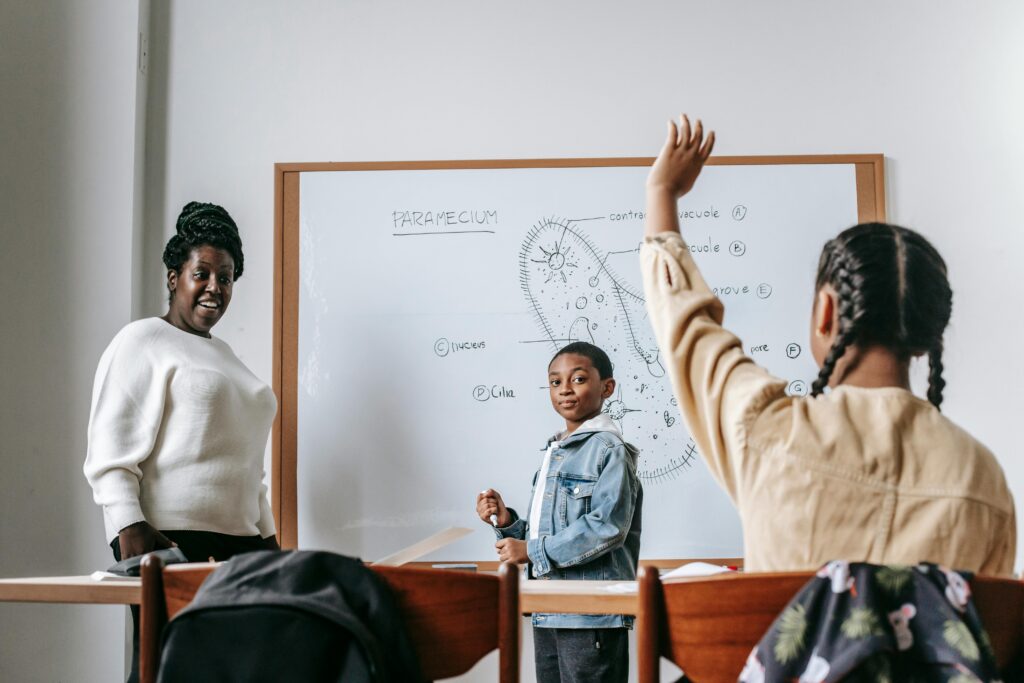
Because here’s the uncomfortable truth we don’t say often enough in learning and development spaces: you can’t become what you never see. If we want our young women to become leaders in business, in politics, in entrepreneurship, or in the community, we need to give them the opportunity to see such people in action — people like you and me. We need to provide them with visible, accessible role models.
Credibility is not built on competence alone. It is built at the intersection of believability and visibility.
Believability comes from substance: your qualifications, your skills, your experience, your track record, your judgement. It is the quiet, disciplined work of becoming good at what you do. Visibility, on the other hand, is about presence: being seen, being heard, being recognised as someone whose voice matters in the room, in the industry, and in the public record.
Too many professional women invest heavily in believability and treat visibility as optional, indulgent, or even distasteful. We assume that if we are good enough, we will be noticed. That our work will speak for itself, and someone, somewhere, will connect the dots.
But in the real world — especially in learning environments, leadership pipelines, and succession planning — credibility is constructed, not discovered. If believability is the foundation, visibility is the structure built on top of it. Without both, the house simply doesn’t stand.
When capable women remain invisible, the result is not humility — it is erasure. Decision-makers scan the landscape and conclude that expertise is scarce. Young women scan the horizon and see no one they can model themselves after. The absence is interpreted as a lack of substance, not a surplus of modesty.
Every time a credible woman chooses invisibility, she doesn’t just limit her own influence — she collapses the learning pathway for those watching from below, trying to understand what credibility looks like in practice.
While a measure of modesty is understandable and perhaps even desirable, a lifelong habit of placing your lamp under a bushel is not really helpful at all. The reason is that it doesn’t just affect you — it affects the generations that follow us. It is in fact, about all the other women whose lives stand to be transformed by your story. If they never get to hear your story, then you’ve stolen their opportunity for transformation.
As a mom of girls, ~I am constantly asking myself questions about teh future of girls in Africa. How many will make it through high school? How many will go on to be high achievers in business, in science, in academia, in the corporate world, in sport, or anywhere for that matter? How many will fulfill their potential? Not because this measure of excelling is the only thing that validates their existence, but because women are in fact incredibly useful in all these sectors, and would make a huge impact on society as a whole.
The truth is, women are exceptional financial managers. Women are more successful at reaching consensus on important global issues, across a wide range of disparate views. Women communicate better than men, and tend to handle stress better than men. Women are able to work longer and harder than men and are better at innovation. They have better people skills, are better at strategy development and so much more.
It’s not that we are in competition against men. It’s just that we lose so much goodness when women aren’t included.
When we have something wonderful, we ought to share it. And, as the statistics show, our women are phenomenal in so many ways. We need to share their achievements and stories with everyone, and particularly with younger women, so they can know what is possible. More importantly, they can know that if it’s possible for anyone, then it’s possible for them too. If you won’t shine for yourself, shine for the women coming after you.
Amazing and thoughtful write – up my leader. You have empowered women like me to realize purpose. It is quite awakening and encouraging that all women may take-up the leading roles in building sources of information and firm foundations for use by the generations come. thank you.